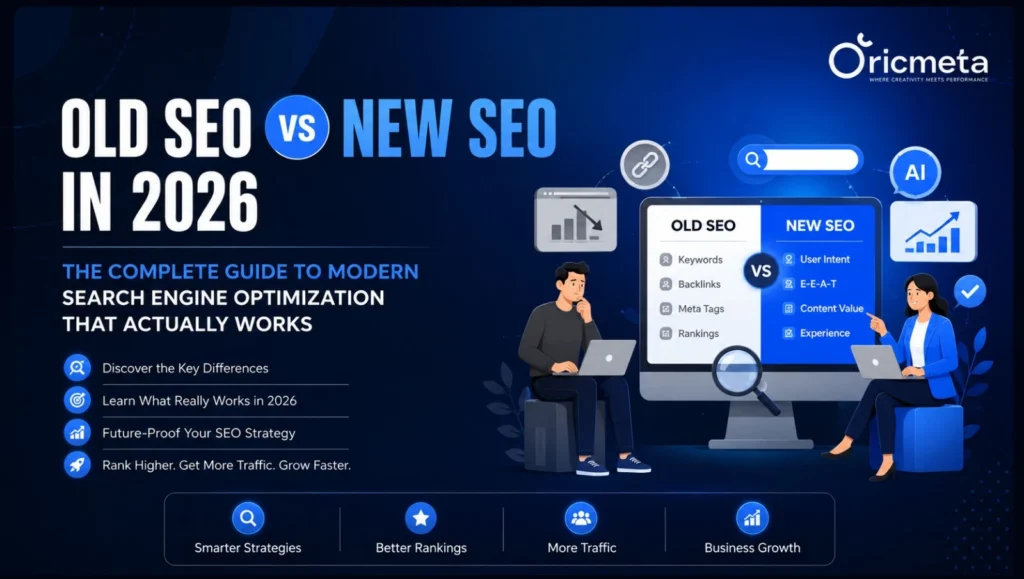
Old SEO vs New SEO
Old SEO focused on keywords, backlinks, and ranking pages. New SEO in 2026 focuses on users, search intent, AI search engines, topical authority, entities, EEAT, helpful content, and brand trust. Success today means optimizing not only for Google Search but also for ChatGPT, Google AI Overviews, Gemini, Perplexity, Bing AI, and voice search.
The Biggest SEO Shift Since Google Was Created
Ten years ago, SEO was surprisingly predictable.
Find a keyword.
Write a 1,000-word article.
Repeat the keyword several times.
Build backlinks.
Wait for rankings.
For many websites, that formula worked.
Today, it doesn’t.
Google has evolved from matching keywords to understanding meaning.
Search has evolved from pages to answers.
Users have evolved from typing “best SEO agency” to asking:
“Which SEO agency can help my SaaS startup rank in AI Overviews?”
That single change explains why thousands of websites lost traffic after Google’s Helpful Content updates while others experienced explosive organic growth.
As SEO professionals, we’re no longer optimizing only for Google’s blue links.
We’re optimizing for an entire ecosystem of AI-powered search experiences.
These include:
- Google AI Overviews
- ChatGPT
- Gemini
- Perplexity
- Bing AI
- Voice assistants
- Conversational search engines
This is the beginning of Search Engine Optimization 2.0.
What Was Old SEO?
Old SEO mainly focused on manipulating ranking signals.
The primary objective wasn’t necessarily helping users it was helping algorithms recognize a page as “relevant.”
Typical activities included:
- Keyword stuffing
- Exact match domains
- Buying backlinks
- Directory submissions
- Article spinning
- Thin content
- Private Blog Networks (PBNs)
- Over-optimized anchor text
- Mass guest posting
- Duplicate landing pages
At that time, Google relied heavily on matching keywords.
If someone searched:
Best Digital Marketing Agency
Pages repeating that exact phrase many times often ranked.
Quality wasn’t always the deciding factor.
What is New SEO in 2026?
Modern SEO is no longer about ranking pages.
It is about becoming the most trusted source of information.
Google now evaluates:
- Experience
- Expertise
- Authority
- Trustworthiness
- User satisfaction
- Helpful content
- Brand reputation
- Content depth
- Search intent
- Entity relationships
Instead of asking:
“How many keywords should I use?”
Successful SEOs ask:
“What is the user’s complete journey?”
Old SEO vs New SEO Comparison Table
| Old SEO | New SEO (2026) |
| Keyword stuffing | Search intent optimization |
| Quantity backlinks | Quality authority links |
| Exact match keywords | Semantic keywords |
| Thin articles | Comprehensive topical guides |
| Page optimization | Entity optimization |
| Google only | Google + AI Search Engines |
| Ranking pages | Solving problems |
| Robots first | Humans first |
| Manual link building | Digital PR & authority mentions |
| Static websites | Experience-focused websites |
| Keyword density | Topic coverage |
| One article | Topic clusters |
| Traffic | Business outcomes |
| Clicks | Engagement |
| SEO tools only | AI-assisted SEO workflows |
Why SEO Changed So Dramatically
Several major technological shifts transformed search.
1. Google Understands Language
Google no longer reads individual words.
It understands context.
Example:
Instead of matching:
“best seo company”
Google understands:
- SEO agency
- digital marketing partner
- AI SEO agency
- enterprise SEO firm
- local SEO company
This is semantic understanding.
2. AI Changed Search Behavior
Users increasingly ask complete questions.
Instead of:
SEO
People search:
How do I optimize my website for ChatGPT and Google AI Overviews?
This requires contextual answers not keyword repetition.
3. Google Rewards Helpful Content
Today’s ranking pages usually contain:
- Original insights
- Real experience
- Case studies
- Expert opinions
- Visual explanations
- Data
- Comparisons
- Practical examples
Generic AI-generated content struggles because it rarely adds new information.
The Rise of AI Search
Search is no longer limited to Google.
Millions now search using:
- ChatGPT
- Gemini
- Perplexity
- Bing AI
These platforms don’t simply rank pages.
They retrieve trusted information.
That means your content must be:
- Well-structured
- Factually accurate
- Clearly written
- Entity-rich
- Easy to cite
- Easy for AI systems to understand
The New SEO Formula
Today’s winning formula looks like this:
Search Intent
↓
Helpful Content
↓
Semantic Coverage
↓
Entity Optimization
↓
EEAT
↓
Brand Signals
↓
Technical SEO
↓
User Experience
↓
Authority Mentions
↓
AI Visibility
This replaces the outdated approach of simply targeting keywords and acquiring backlinks.
The 10 Biggest Ranking Factors in 2026
1. Search Intent
Google wants the best answer not the page with the most keywords.
Before writing, ask:
- Why is the user searching?
- What problem are they solving?
- What action will they take next?
2. Topical Authority
Publishing one article is no longer enough.
Google prefers websites that comprehensively cover an entire subject.
Example:
Instead of writing only:
“SEO”
Create a complete ecosystem:
- Technical SEO
- On-page SEO
- Off-page SEO
- Entity SEO
- AI SEO
- Google AI Overviews
- EEAT
- Schema
- Internal Linking
- Content Clusters
- NLP SEO
This creates topical authority.
3. Entity SEO
Google recognizes entities instead of just keywords.
Examples include:
- Brands
- People
- Products
- Organizations
- Locations
- Technologies
When your brand becomes an entity, Google understands who you are not just what keywords you target.
4. EEAT
Experience now matters more than ever.
Google increasingly favors content written by people who have actually done the work.
Ask yourself:
Can readers tell you’ve solved this problem before?
If not, your content may struggle against more experience-driven competitors.
5. Information Gain
Don’t repeat what’s already ranking.
Add something genuinely useful.
Examples include:
- Original frameworks
- Proprietary checklists
- Custom templates
- Real client insights
- New statistics
- Step-by-step workflows
- Personal observations from campaigns
This “information gain” helps distinguish your content from commodity articles.
6. User Experience
Ranking isn’t enough.
If users leave immediately, rankings often decline over time.
Modern UX signals include:
- Fast loading speed
- Clear navigation
- Mobile responsiveness
- Readable typography
- Helpful visuals
- Logical content structure
7. Internal Linking
Every important page should connect naturally to related content.
A strong internal linking strategy:
- Distributes authority
- Improves crawlability
- Increases time on site
- Helps search engines understand topical relationships
Think in clusters, not isolated posts.
8. Structured Data
Schema markup helps search engines interpret your content.
Essential schema types include:
- Article
- FAQ
- Breadcrumb
- Organization
- Person
- HowTo
- Review (where applicable)
Proper structured data also increases eligibility for rich results.
9. Brand Signals
Google increasingly rewards recognizable brands.
Strong brand signals come from:
- Consistent publishing
- Expert authorship
- Mentions across authoritative websites
- Positive reviews
- Active social presence
- High-quality backlinks
A trusted brand is more resilient to algorithm updates than an anonymous website.
10. AI-Friendly Content
AI systems prefer content that is:
- Clearly organized with headings
- Rich in definitions and concise answers
- Backed by evidence or experience
- Easy to quote and summarize
- Free of unnecessary fluff
This improves the likelihood of being referenced in AI-generated answers.
Modern SEO Strategies That Actually Work in 2026
The biggest misconception in SEO today is believing that ranking on Google alone is enough.
In reality, your content is now competing for visibility across:
- Google Search
- Google AI Overviews
- ChatGPT
- Gemini
- Perplexity
- Bing AI
- Voice Assistants
- Smart Search Interfaces
Instead of optimizing for one algorithm, successful SEO professionals optimize for information retrieval systems.
Think of SEO in 2026 as:
Search Everywhere Optimization (SEO).
The Modern SEO Framework (2026)
Instead of following a simple checklist, use this growth framework:
Audience Research
↓
Search Intent
↓
Topic Cluster
↓
Entity Optimization
↓
Helpful Content
↓
Technical SEO
↓
EEAT Signals
↓
Internal Links
↓
Authority Links
↓
AI Search Visibility
↓
Organic Business Growth
1. AI Search Optimization Is the New SEO
AI search engines don’t rank websites the way traditional search engines do.
Instead, they retrieve trusted information and generate answers.
How AI Search Works
User asks question
↓
AI Understands Intent
↓
Searches Trusted Sources
↓
Extracts Relevant Information
↓
Generates Answer
↓
Mentions Brands It Trusts
If your website is difficult to understand, AI won’t use it.
How to Optimize for AI Search
Write Direct Answers
Instead of writing:
SEO is important because…
Write:
SEO helps websites increase organic traffic by improving visibility in search engines and AI-powered search platforms.
Clear.
Simple.
Easy to quote.
Use Question-Based Headings
Instead of
Benefits
Write
What Are the Benefits of SEO?
AI systems love question-answer structures.
Add Definition Boxes
Example
Definition
Semantic SEO is the process of creating content around topics, entities, relationships, and user intent rather than focusing only on keywords.
Definition boxes frequently appear in AI-generated answers.
AI Optimization Checklist
✅ Direct answers
✅ Tables
✅ Bullet lists
✅ FAQs
✅ Definitions
✅ Statistics
✅ Examples
✅ Entity mentions
✅ Structured headings
✅ Original insights
Google AI Overview Optimization
Google AI Overviews have fundamentally changed organic search.
Instead of displaying ten blue links first, Google now provides a synthesized answer from multiple trusted sources.
Pages More Likely to Appear
- Comprehensive guides
- Expert-written articles
- Research-backed content
- Original insights
- Updated statistics
- Strong EEAT signals
- Structured content
AI Overview Friendly Structure
Question
↓
40-word Answer
↓
Detailed Explanation
↓
Examples
↓
Table
↓
FAQ
↓
Sources
How ChatGPT Chooses Content
Although retrieval methods evolve, content that is clear, accurate, and well-structured is generally easier for AI systems to summarize.
Characteristics include:
- Logical organization
- Strong topical coverage
- Clear explanations
- Brand authority
- Fresh information
- Expert insights
- Natural language
How Gemini Understands Websites
Gemini emphasizes context.
It connects:
Topics
↓
Entities
↓
Relationships
↓
Intent
↓
Trust Signals
Instead of optimizing only one keyword:
“SEO”
Cover related concepts naturally:
- Technical SEO
- Semantic SEO
- Search Intent
- EEAT
- Schema
- Content Marketing
- Internal Linking
- UX
- AI Search
- Brand Authority
Perplexity SEO Strategy
Perplexity frequently references sources that provide:
- Comprehensive explanations
- Data-backed content
- Original research
- Well-organized formatting
- Helpful comparisons
To improve your chances of being cited:
- Include concise summaries before detailed sections.
- Support claims with reputable references where appropriate.
- Add original examples and practical insights instead of repeating common advice.
Entity SEO: The Future of Rankings
Google doesn’t just understand keywords anymore.
It understands entities.
Examples of Entities
| Entity | Example |
| Person | SEO Consultant |
| Company | Oricmeta |
| Product | Google Search Console |
| Organization | |
| Technology | AI Search |
| Service | AI SEO Services |
When Google understands relationships between entities, it becomes easier to establish topical authority.
How to Build Entity Authority
Instead of publishing isolated blogs:
Create an ecosystem.
Example
SEO
↓
Technical SEO
↓
AI SEO
↓
Entity SEO
↓
Schema
↓
Core Web Vitals
↓
Google AI Overview
↓
Helpful Content
↓
Link Building
↓
Content Clusters
Now Google understands:
This website specializes in SEO.
Semantic SEO: Think Topics, Not Keywords
Old SEO
Target one keyword.
Example
SEO Agency
New SEO
Cover the complete topic.
Include:
- SEO
- Search Intent
- Technical SEO
- Schema
- Core Web Vitals
- Content Clusters
- AI Search
- EEAT
- Internal Links
- User Experience
Semantic SEO answers every relevant question a reader might have.
Content Clusters: Build Topical Authority
A content cluster consists of one pillar page supported by multiple related articles.
Example cluster for an SEO website:
| Pillar Page | Supporting Articles |
| Old SEO vs New SEO | Technical SEO Checklist |
| SEO Trends 2026 | AI SEO Guide |
| SEO Strategy | Entity SEO Explained |
| Google Ranking Factors | Schema Markup Guide |
| SEO for Beginners | Internal Linking Strategy |
| AI Search Optimization | Google AI Overview SEO |
This structure helps search engines understand your expertise.
Information Gain: Stop Repeating Everyone Else
Google increasingly rewards content that contributes something new.
Instead of rewriting existing articles, add:
- Original frameworks
- Campaign insights
- Before-and-after results
- Case studies
- Proprietary templates
- Expert opinions
- Actionable checklists
Ask yourself:
“What will readers learn here that they can’t find elsewhere?”
EEAT: Experience Matters More Than Ever
Google’s quality systems increasingly value content that demonstrates:
- Real-world experience
- Subject expertise
- Authority in the field
- Trustworthiness
Ways to Improve EEAT
- Publish author bios.
- Share real campaign experiences.
- Use screenshots and examples.
- Keep articles updated.
- Cite authoritative sources when discussing statistics or standards.
- Be transparent about methods and limitations.
Technical SEO Checklist for 2026
Technical SEO remains essential because it ensures search engines can efficiently crawl, understand, and render your site.
Crawlability
- XML Sitemap
- Robots.txt
- Canonical Tags
- No Broken Links
- Clean URL Structure
Indexing
- Indexed Important Pages
- Remove Thin Pages
- Fix Duplicate Content
- Optimize Crawl Budget
Performance
- Core Web Vitals
- Mobile Optimization
- Fast Server Response
- Image Compression
- Lazy Loading
- Efficient CSS and JavaScript Delivery
Structured Data
Implement schema where appropriate:
- Organization
- Website
- Article
- FAQ
- Breadcrumb
- Person
- HowTo
- Product (for eCommerce)
Core Web Vitals Still Matter
User experience remains a strong quality signal.
Focus on:
| Metric | Target |
| Largest Contentful Paint (LCP) | Under 2.5 seconds |
| Interaction to Next Paint (INP) | Under 200 ms |
| Cumulative Layout Shift (CLS) | Under 0.1 |
Improving these metrics benefits both rankings and conversions.
Internal Linking Strategy
Many websites lose rankings because their content is isolated.
A strong internal linking strategy helps:
- Pass authority
- Improve crawlability
- Increase session duration
- Strengthen topical relevance
Example:
SEO Guide
↓
AI SEO
↓
Technical SEO
↓
Schema
↓
Content Clusters
↓
Internal Linking
↓
Google AI Overview
Backlink Strategy in 2026
Forget quantity.
Focus on quality.
Prioritize:
- Digital PR
- Industry publications
- Expert interviews
- High-quality guest posts
- Original research
- Link-worthy resources
- Strategic partnerships
Natural editorial links from trusted websites are far more valuable than large volumes of low-quality backlinks.
How Oricmeta Approaches Modern SEO
Modern SEO requires more than publishing blogs or acquiring backlinks. It combines technical optimization, content strategy, user experience, performance marketing, and AI-ready information architecture.
Oricmeta | Creative AI Digital Marketing Agency follows this integrated approach by offering services such as Technical SEO, Content Creation, Link Building, Web Development, Performance Marketing, and Analytics. This aligns with how search engines increasingly evaluate websites based on overall quality, usability, and authority rather than isolated SEO tactics.
For businesses seeking long-term growth, investing in AI SEO Services and high-quality guest posting on authoritative websites can improve brand visibility, organic traffic, and trust when executed as part of a broader, user-first SEO strategy rather than as standalone tactics.
Common SEO Mistakes in 2026
Avoid these frequent pitfalls:
❌ Publishing AI-generated content without human review.
❌ Targeting keywords instead of user intent.
❌ Ignoring AI search platforms.
❌ Producing thin, repetitive articles.
❌ Neglecting internal linking.
❌ Chasing large volumes of low-quality backlinks.
❌ Forgetting mobile performance.
❌ Skipping schema markup.
❌ Failing to update outdated content.
❌ Treating SEO as separate from branding and user experience.
Google Discover Optimization: How to Get More Traffic in 2026
Ranking on Google Search is no longer the only goal.
Google Discover introduces your content to users before they even search, making it one of the highest-potential traffic sources for publishers and businesses.
Unlike traditional SEO, Discover prioritizes user interest, engagement, freshness, and authority over exact keyword matching.
How Google Discover Chooses Content
Google Discover evaluates several quality signals, including:
- Original insights and perspectives
- High-quality featured images (minimum 1200px wide)
- Strong topical authority
- Engaging headlines
- Fresh, updated content
- Positive user engagement
- Brand trust and consistency
- Mobile-first user experience
Discover Optimization Checklist
| Factor | Best Practice |
| Headlines | Emotional but accurate |
| Images | Original, high resolution |
| Content | Helpful, experience-driven |
| Mobile UX | Fast and responsive |
| Brand | Consistent publishing |
| Freshness | Update content regularly |
| Internal Links | Connect related articles |
| EEAT | Demonstrate expertise and trust |
Zero-Click Search Optimization
More than half of many informational searches now end without a click because users receive answers directly on the search results page through AI Overviews, featured snippets, or knowledge panels.
Instead of fighting zero-click searches, optimize your content to become the source of those answers.
How to Win Zero-Click Searches
- Answer questions in the first paragraph.
- Keep definitions between 40–60 words.
- Use bullet points for processes.
- Include comparison tables.
- Add FAQ sections.
- Implement FAQ and Article schema.
- Structure headings clearly.
Featured Snippet Optimization
Featured snippets remain one of the fastest ways to increase visibility.
What is Old SEO vs New SEO?
Old SEO focused on keyword optimization, backlinks, and ranking web pages. New SEO focuses on search intent, topical authority, AI search optimization, EEAT, entity SEO, user experience, and delivering comprehensive answers across Google and AI-powered search engines.
This concise definition is optimized for snippet eligibility.
How to Rank for Featured Snippets
Step 1
Identify question-based keywords.
Step 2
Answer the question immediately.
Step 3
Expand with examples.
Step 4
Add visuals.
Step 5
Support with tables.
Step 6
Add FAQs.
Voice Search SEO
Voice search queries are becoming increasingly conversational.
Instead of typing:
SEO 2026
Users ask:
“What is the best SEO strategy for ranking in AI search engines?”
Optimize for Voice Search
- Use conversational language.
- Include long-tail keywords.
- Answer questions directly.
- Keep paragraphs concise.
- Write naturally.
- Add FAQ sections.
- Optimize for local searches where relevant.
AI-Friendly Content Writing Framework
Create content that is easy for both humans and AI systems to understand.
The A.I.M. Framework
A Answer First
Provide the direct answer immediately.
I Inform Deeply
Expand with examples, explanations, and comparisons.
M Make It Actionable
End each section with practical next steps.
Complete SEO Checklist for 2026
Keyword Research
✔ Focus on search intent.
✔ Target topic clusters.
✔ Use semantic keywords.
✔ Analyze AI search trends.
✔ Identify entity opportunities.
Content Optimization
✔ Original research.
✔ Practical examples.
✔ Clear headings.
✔ Definitions.
✔ FAQs.
✔ Comparison tables.
✔ Helpful visuals.
✔ Information gain.
Technical SEO
✔ XML Sitemap
✔ Robots.txt
✔ Canonical URLs
✔ HTTPS
✔ Core Web Vitals
✔ Mobile optimization
✔ Schema markup
✔ Crawl error fixes
✔ Image optimization
✔ Internal linking
Authority Building
✔ Digital PR
✔ Editorial backlinks
✔ Brand mentions
✔ Thought leadership
✔ Guest posting on authoritative websites
✔ Consistent publishing
AI Search Optimization
✔ Clear answers
✔ Conversational content
✔ Entity optimization
✔ Topical authority
✔ Natural language
✔ Structured formatting
✔ Accurate information
✔ Regular updates
Future of SEO Beyond 2026
SEO is evolving from optimizing pages to building trusted digital brands.
Future success will depend on:
- AI-assisted content workflows (with human oversight)
- Entity-based optimization
- Search intent understanding
- Personalized search experiences
- Multimodal search (text, image, video, voice)
- Brand authority
- High-quality first-party data
- Continuous content improvement
The websites that invest in trust, expertise, and unique value will continue to perform well even as search technology changes.
Beginner Mistakes to Avoid
| Mistake | Better Approach |
| Keyword stuffing | Write naturally around user intent |
| Publishing thin articles | Create comprehensive guides |
| Buying spammy backlinks | Earn editorial mentions |
| Ignoring technical SEO | Regular technical audits |
| No internal linking | Build topic clusters |
| Copying competitors | Add original insights |
| Publishing without updates | Refresh content regularly |
| Chasing rankings only | Focus on user outcomes |
Conclusion
The debate around old SEO vs new SEO isn’t about abandoning proven fundamentals it’s about adapting them to a search landscape shaped by AI, user intent, and trust.
Technical SEO, on-page optimization, and quality backlinks still matter, but they are no longer enough on their own. Today’s highest-performing websites combine those foundations with topical authority, entity SEO, semantic content, EEAT, exceptional user experience, and AI-ready information architecture.
Businesses that continue relying on outdated tactics such as keyword stuffing, thin content, or low-quality backlinks will struggle to compete. In contrast, brands that invest in original expertise, comprehensive content, and a people-first strategy are far more likely to earn visibility across Google Search, AI Overviews, ChatGPT, Gemini, Perplexity, Bing AI, and future search experiences.
If you’re looking to build sustainable organic growth, focus on creating genuinely useful content, strengthening your brand, and optimizing for both traditional search engines and AI-powered discovery.
For organizations seeking expert guidance, Oricmeta | Creative AI Digital Marketing Agency combines Technical SEO, AI SEO Services, content strategy, web development, performance marketing, and authoritative guest posting into a unified digital growth approach. Their emphasis on customized strategies, technical excellence, and long-term brand visibility reflects the direction modern SEO is heading.
Whether you’re a startup, SaaS company, eCommerce brand, local business, or enterprise, adopting Affordable AI SEO Services and a future-focused SEO strategy today will help position your business for sustainable growth in 2026 and beyond.
Final Expert Takeaway
Old SEO optimized for search engines. New SEO optimizes for people, AI systems, and trust. The websites that combine expertise, original insights, technical excellence, and strong brand authority won’t just rank higher they’ll become the sources that both users and AI rely on.
People Also Ask (PAA)
Is traditional SEO still relevant in 2026?
Yes. Core practices such as technical SEO, on-page optimization, and quality link building remain important. However, they must now be combined with AI search optimization, EEAT, semantic SEO, and strong user experience.
Does AI replace SEO?
No. AI changes how users discover information, but SEO remains the process of making content understandable, trustworthy, and accessible across both traditional and AI-powered search platforms.
What is the biggest SEO trend in 2026?
The biggest trend is optimizing for AI-driven search experiences through topical authority, entity SEO, structured content, and experience-based information.
Frequently Asked Questions
1. What is the difference between old SEO and new SEO?
Old SEO relied heavily on keywords and backlinks. New SEO emphasizes search intent, user experience, topical authority, EEAT, semantic relevance, and AI-friendly content.
2. Is keyword research still important?
Yes, but modern keyword research focuses on understanding topics, entities, and user intent rather than targeting isolated keywords.
3. What is AI SEO optimization?
AI SEO optimization involves creating content that can be accurately understood, summarized, and cited by AI-powered search systems while remaining valuable to human readers.
4. How do Google AI Overviews affect SEO?
They reward content that is authoritative, well-structured, and provides direct, comprehensive answers.
5. What is topical authority?
Topical authority is built by publishing multiple interconnected, high-quality articles that comprehensively cover a subject area.
6. Is link building still important?
Yes. Quality editorial backlinks and digital PR remain valuable ranking signals, while manipulative link schemes carry greater risk.
7. What role does EEAT play in SEO?
EEAT helps search engines evaluate whether content demonstrates real experience, expertise, authority, and trustworthiness.
8. How often should I update SEO content?
Review important content every 3–6 months or sooner if there are significant industry changes.
9. What is entity SEO?
Entity SEO focuses on helping search engines understand the people, brands, products, organizations, and concepts connected to your content.
10. Can small businesses compete with large brands?
Yes. By specializing in a niche, producing original content, and building trust over time, smaller businesses can earn strong visibility.
11. Is AI-generated content bad for SEO?
Not inherently. Content created with AI should be reviewed, improved, fact-checked, and enhanced with original expertise before publishing.
12. What is information gain?
Information gain means contributing unique insights, research, examples, or perspectives instead of repeating what already exists online.
13. Which SEO metrics matter most?
Track:
- Organic traffic
- Qualified leads
- Conversions
- Engagement
- Rankings for key topics
- Click-through rate (CTR)
- AI search visibility
- Indexed pages
- Core Web Vitals
14. How long does SEO take in 2026?
Many websites begin seeing meaningful improvements within 3–6 months, though timelines vary based on competition, site quality, and resources.
15. What is the best long-term SEO strategy?
Build topical authority, publish original experience-based content, maintain technical excellence, earn trusted mentions, and continuously improve user experience.