You’re writing blogs, including keywords, building backlinks and investing in your website to improve its SEO. However, you’re still struggling to rank on Google or generate leads and customers from your website traffic
Does this ring a bell?
Maybe you’re not using the right areas in your SEO strategy.
Many businesses get bogged down with checklists. They write blogs, include keywords, create good meta descriptions and backlinks; however, these will not create a successful SEO strategy.
SEO can be a complex process made up of technical work, quality content, knowing what people want to search for, good user experience and having good analytical data.
Let’s take a look why your SEO strategy may not be working and how to help it work.
Quick Answer: Why Is Your SEO Strategy Not Working?
Many SEO strategies suffer from poor keyword targeting, failure to consider search intent, poor quality content, failing to address technical issues and attracting non-converting traffic.
This can be overcome with a website audit, better keyword targeting, quality content creation, technical SEO improvements, high quality backlinks and ongoing monitoring of performance.
Why isn’t your SEO working?
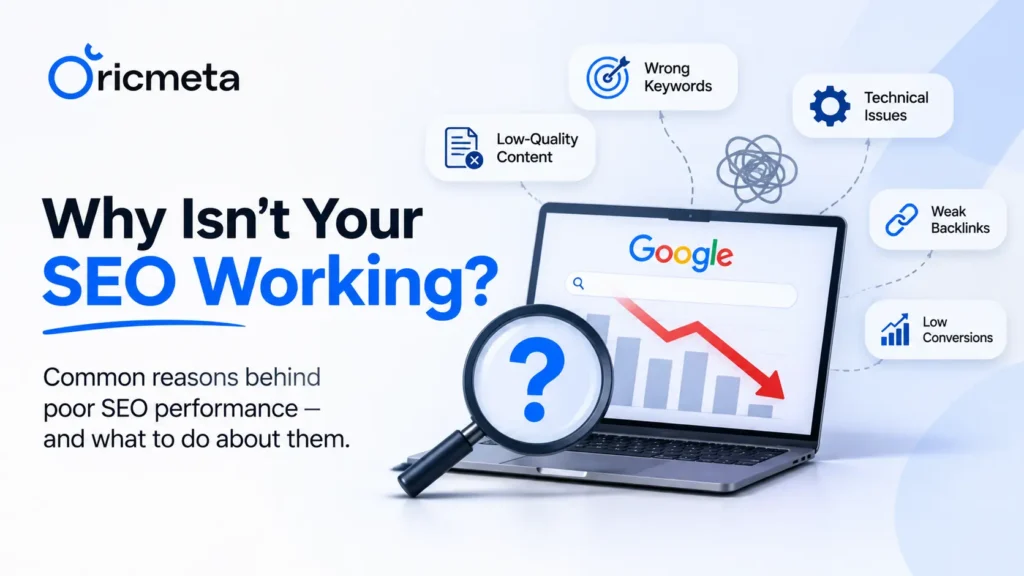
Before we make any further changes, let’s find out why your website isn’t performing well.
1. Keyword targeting without knowing search intent
One of the most common mistakes is targeting keywords based on search volume.
For example, if you were to search ‘what is website development’ you would be looking for information, whereas someone searching ‘website development company for startups’ may be looking to gain a service.
Fix:
- Know the intent behind the searched keyword (Informational, Commercial, Navigational & Transactional).
- Target keywords which relate to your products/services and overall customer journey.
- Create separate pages for information and commercial keywords.
2. Content not providing value
Regularly publishing content won’t help your website rank.
If you’re publishing articles that don’t provide any real value, then there is little incentive for your reader to pick your content over your competitors.
Fix:
- Answer real customer questions.
- Use examples, and provide unique insights.
- Ensure you’re keeping the content up to date.
- Create clusters of content around your key services.
- Include relevant links.
Google recommends creating content that provides value to your audience, is trustworthy, and is written for people.
3. Technical SEO issues
Even if you have good quality content, if your website isn’t being crawled, indexed and understood by search engines it will struggle to perform.
Common technical issues include:
- Broken links and incorrect redirects.
- Noindex pages.
- Duplicate content and incorrect canonical tags.
- Slow loading pages.
- Poor mobile usability.
- Incorrect sitemap/robots.txt.
Fix: Carry out a technical SEO audit, check Google Search Console, look at your indexing issues and monitor your Core Web Vitals.
4. Poor On-Page SEO
You may have good content, but search engines and visitors need a clear understanding of what is on each page.
Improvements to include:
- Page title.
- Meta description.
- Correct heading tags (H1, H2 & H3).
- Correct keyword usage.
- Image alt text.
- Internal linking.
- Clear URL & page structure.
Don’t stuff your content full of keywords. Keep it relevant.
5. Not focusing on backlinks & brand authority
Although having great content is important, building brand recognition from other relevant websites can boost your SEO.
A website with few quality backlinks may struggle to compete within a competitive industry.
Fix:
- Create useful resources within your industry.
- Create genuine partnerships within your industry.
- Provide valuable insights from experts within your industry.
- Create relevant editorial backlinks.
Don’t pay for spammy links or get involved with link schemes.
6. High traffic, low leads
Having more organic traffic doesn’t always mean you’ll gain more customers.
An e-commerce website may attract thousands of visitors but still generate very few enquiries or sales. This could happen when visitors arrive through informational blogs but aren’t guided towards relevant products or purchase pages.
This may be due to the intent behind the keyword not matching the landing page content, or the next step.
Fix:
- Create service/product landing pages.
- Have clear calls to action.
- Keep your contact form simple.
- Ensure your site is easy to navigate and mobile friendly.
- Track quality leads.
7. Not tracking your SEO
Without tracking your SEO it’s just a guess.
Keep track of the following metrics.
| Metric | Purpose |
| Organic Clicks | Show how many people are visiting from search. |
| Impressions | Shows how much visibility you have. |
| CTR | Shows how often impressions are turning into clicks. |
| Avg Position | Shows how well your site is ranking. |
| Conversions | Shows how many actions are happening on your website. |
| Indexed | Shows how many pages are being indexed. |
| Referring Domains | Shows how many websites are linking to you. |
Use Google Search Console & Google Analytics 4 to understand how your site is performing and where you can improve.
How To Fix Your SEO Strategy
Once you know what is wrong with your strategy, you can start to improve it.
1. Perform an SEO Audit
Perform an audit covering:
- Technical issues
- Content quality
- Indexing
- Backlinks
- Website structure
- Rankings
2. Find the right Keywords
Find keywords that are relevant to:
- Customer pain points/questions
- Search intent
- Your business
- Competitors
- Buyer stage
3. Create a Content Strategy
Group your content around topics.
For example, if you are a digital marketing agency, you could create one main guide around your SEO and then create content around keyword research, technical SEO, local SEO and content optimisation.
4. Improve existing pages
Identify any existing pages on your site that are performing but have a low CTR or decreasing clicks.
Ensure they are improving by making them more relevant, having a good structure, title and content.
5. Increase website authority
Ensure you are building quality backlinks, keeping your branding consistent and creating quality content to show your authority.
6. Track, test and improve
Track how your content is performing once a month.
Work out what is working, find out why things aren’t and make improvements based on the potential impact on your business.
SEO in the Age of AI Search and Google Discover
SEO is evolving, people are no longer relying exclusively on traditional Google results. They are also discovering information through Google AI Overviews, ChatGPT, Gemini, and Perplexity.
This makes it important to build visibility beyond conventional keyword rankings.
| Area | What Your Strategy Should Focus On |
| Traditional SEO | Technical health, keywords, content, backlinks |
| AEO | Clear answers to relevant user questions |
| GEO | Useful, credible information that AI systems can understand and reference |
| Google Discover | Engaging, timely, original, people-first content |
How to improve AI Search Visibility
- Answer key questions.
- Use descriptive titles and explanations.
- Backup your claims with a reliable source.
- Create valuable original content.
- Ensure consistent branding and business details.
- Ensure that key content is visible to crawlers.
Google has confirmed that these core SEO principles do still apply to their generative AI search. There is no guaranteed quick win or secret weapon for AEO/GEO.
What About Google Discover?
Google Discover is another great way to reach your audience with your content recommendations based on interests.
To improve your eligibility and content quality:
- Create interesting and relevant stories.
- Write accurate and intriguing headlines.
- Include unique insights and up-to-date information.
- Add high quality featured images (1200px+).
- Use the max-image-preview:large setting.
- Don’t use misleading headlines and clickbait.
Note: Eligibility doesn’t guarantee placement.
How Oricmeta Technologies Can Help
There are times when you will need help creating a checklist to ensure that you have a coherent SEO strategy in place.
At Oricmeta Technologies we can help by providing you with an SEO strategy. Our approach is to help highlight any issues that may be holding your website back and create a strategy to help you achieve your business goals.
We provide various services including:
- SEO Audit – Find technical errors, indexation and optimisation opportunities
- Keyword Research – Understand what keywords are relevant
- Technical SEO – Help improve the structure, crawlability and performance of your website.
- SEO Content Writing – Help provide useful content including blogs, landing pages and topic clusters.
- AEO & GEO – Help improve clarity within your content and provide more visibility opportunities.
- Website Development & UI/UX – Create a simple and easy to use website.
- Conversion Rate Optimisation – Highlight issues preventing potential customers from converting into leads.
- Performance Marketing – Targeted campaigns to complement your long term organic growth.
We believe SEO should be helping your business grow.
Have a look at our SEO services to see how we can help you have better visibility in search engines.
Conclusion
Understand your audience, their keywords and check there are no issues on your website.
Ensuring that you provide quality content and understand the correct metrics you can improve your digital presence as the search market grows.
By using techniques such as SEO, AEO, GEO, website development and conversion driven digital solutions you will increase your digital presence.
If you are not seeing the results you want from your website, we can help find out why your SEO is not performing as well as it could be. We can provide a strategy that will help you meet your business goals.
See how we can help you at Oricmeta Technologies. Or get in touch to discuss your digital growth needs.